How space travel can make Earth more sustainable
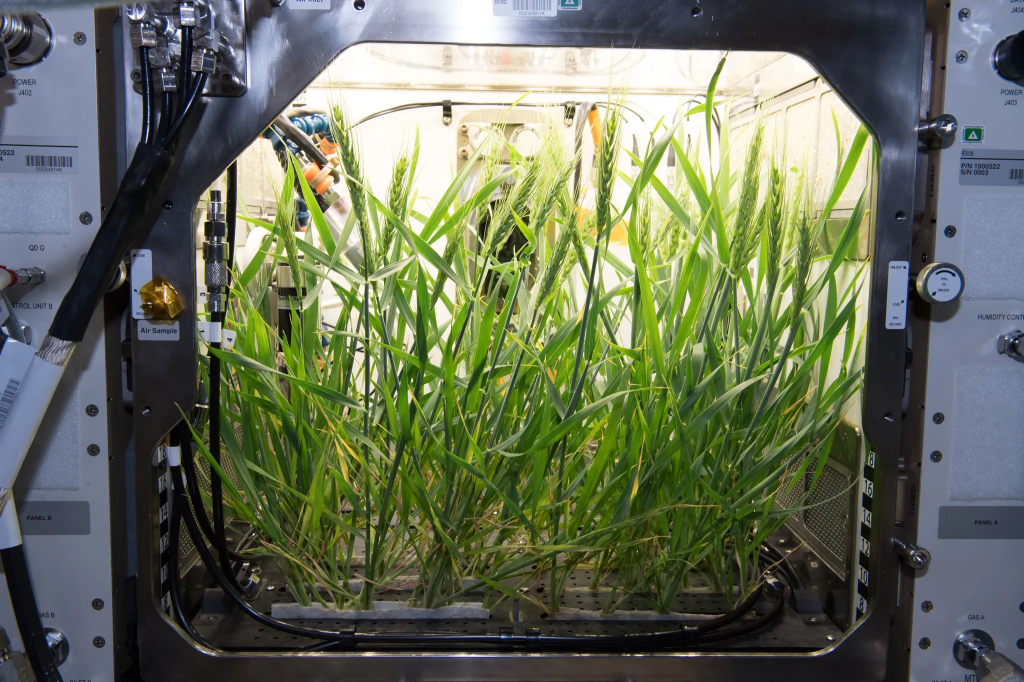
Interest in space travel has peaked since the Artemis II mission last month, with many wondering what this means for the future. What most don’t realise is that extensive research has been carried out on the International Space Station (ISS) for years, research which could eventually be applied to benefit Earth.
Why research plants in space?
Research into plant growth on the ISS was designed so that astronauts living there could grow their own food in microgravity, without the need for cargo deliveries for fresh food. This would mean longer missions could take place at further distances from the Earth. Now it has evolved to include the possible implementation of this research for sustainable food production on Earth.
The ISS provides the perfect experimental conditions as it is a sterile environment, where the only microbes present are those brought in by astronauts. There are many high-tech labs set up with the purpose of researching plant growth, as well as highly trained teams. The biggest benefit though, is the microgravity. This gives researchers the opportunity to understand how plants behave in extreme environments, and to mitigate their stress responses in controlled conditions. This is especially important as worsening global warming means that more extreme weather conditions are increasing on Earth, and we don’t fully understand how plants will respond. The APEX experiments have focused predominantly on this topic (click here to read more about the most recent of these experiments). However, the most recent research, which is still currently being conducted, is Veg-06.
What is Veg-06?
The ISS research department states that Veg-06 is an experiment which set out to research 2 main concepts of plant behaviour. The first is whether plants can form relationships with nitrogen fixing bacteria in extreme conditions. Nitrogen-fixing bacteria are microorganisms which absorb nitrogen from the atmosphere and release it into the soil for plants to absorb. This provides excess nutrients in the soil for plants, allowing them to grow efficiently without depleting the soil. Soils without nitrogen cannot be used again for farming, so it is a very important process. Some plants such as beans and peas form a mutually beneficial relationship between their roots and nitrogen-fixing bacteria which encourages more nitrogen-fixation for further growth. The aim of veg-06 is to understand how the extreme conditions in space impact the formation of these relationships, to be able to apply to Earth (which will be explained further below). They also are studying how stress responses in plants as a result of microgravity impact lignin, the chemical that causes plants to absorb water and grow upright. By decreasing the lignin in plants, non-edible parts can be recycled, and their nutrients can be used for future generations. In space, NASA’s hope is that the veg-06 experiment will mean that food can continue to be replenished without the need for fertilisers. This can also be very useful on Earth.
How can this be used on Earth?
It is a known fact that global warming is causing increasing amounts of extreme weather events such as droughts and floods, which trigger stress responses in plants. The use of nitrogen fertilisers and pesticides also leads to many different environmental issues such as eutrophication and health problems for farmers. As a result it is becoming harder to rely on current agricultural practices to supply the global demand for food.
By studying the relationship between nitrogen-fixation and plants, there becomes more understanding of how it improves soil quality (because there is more nitrogen). This can be used to demonstrate the economic and environmental benefits of agricultural practices which involve planting nitrogen-fixing crops alongside standard crops according to NASA. Even during droughts or other extreme events, food would still be able to be grown and the need for nitrogen fertilisers would be dramatically reduced as the soils would naturally be replenishing themselves with nitrogen. The potential for this is vast as it might lead to there being far less food insecurity globally and more economic benefits for small-scale farmers as they are able to grow more crops.
The data collected on the way that lignin behaves in extreme conditions could have many different applications on Earth. One of which could be modifying the DNA sequence. This might cause plants to be more resistant to extreme weather, as it can allow them to absorb more water in drought and resist stress responses. This has also been heavily researched by Stockholm University, click here for further depth into this. Less lignin can also have benefits because it can allow inedible parts of plants to be recycled, and their nutrients can be used for future generations.
Research is consistently ongoing at the ISS for many different physiological and chemical experiences in space. If you are interested, the links below go further in depth of the concepts written about.
Links
Below are links to read more on this topic if you are interested, and where the information was obtained for this post:
https://issnationallab.org/facilities/vegetable-production-system/
Image: https://www.nasa.gov/exploration-research-and-technology/growing-plants-in-space/
 The Sustainable Lens